Monday, December 26, 2016

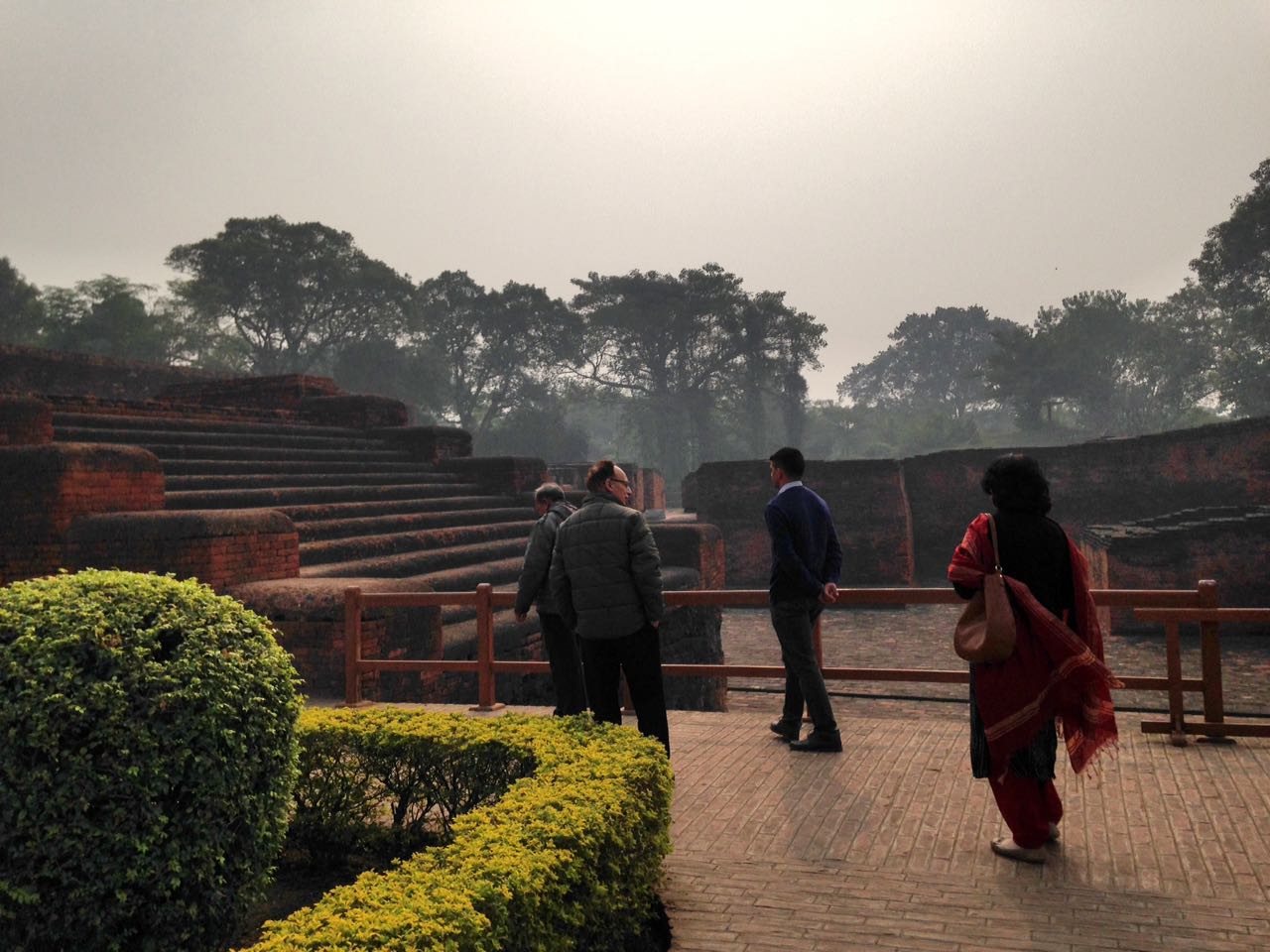
Hiuen Tsang's ( Zuanzang or Xuanzang) memorial , Nalanda

In front of the Hiuen Tsang's ( Zuanzang or Xuanzang) memorial , Nalanda. The Chinese Buddhist scholar lived in the 7th century AD and visited & lived in India for about thirteen years .


Tuesday, December 20, 2016

Nalini Jaywant ,

Today is the death anniversary of Nalini Jaywant , the leading actress of Hindi Cinema during 1940s and '50s.She made her debut as a teenager with Mehboob Khan's film Behan in 1941. Her childlike innocent face also contributed to her success and popularity.Though she acted in a few more films after Bahen, success came to her with the films Samadhi and Sangram, in which she appeared opposite Ashok Kumar.She went on to do more films with Ashok Kumar,like 
Jalpari, Kafila, Nau Bahar,Saloni, Lakewren, , Naaz. etc.In '50s she appeared in films like Shikast, Munim ji, Rahi,Railway Platform, and Hum Sab Chor Hain. Her last successful movie was 1958 film Kala Pani for which she also won the Best Supporting Actress award.Her last movie was Nastik in which she appeared in 1983, after a gap of 18 years.
She died a recluse this day in 2010 in Mumbai.
Our humble tributes to the popular actress !

80 Feet High Statue of Buddha at Bodhgaya


The 25 metre (80 feet) high Statue of Buddha commisioned by the Daijokyo Buddhist organization of Japan. The statue was erected by a Jaipur firm. It was unveiled on 18th November 1989.A landmark of Bodhgaya.The Buddha image is 64 feet in height, the lotus 6 feet and the pedestal 10 feet in height.


Monday, December 19, 2016

Mahabodhi temple, Bodhgaya

Once you are at Gaya, it is a must to visit Bodhgaya , the place with historical religious significance, and a place of pilgrimage for Buddhists all over the world .The place is associated with Prince Siddharth attaining enlightenment and becoming Buddha after meditating for years under a tree known as the Bodhi Tree. On reaching there we headed for the Mahabodhi Temple , an ancient 55 metre high structure . Ignorance is not always a bliss . We had not taken camera with us hoping to click some pictures with the mobile phones.But alas, we were not allowed to carry mobile inside the premises and had to put them back in the vehicle. However inside we did see some foreigners with cameras and mobile lookalike gadgets as well .It can’t be that there were two sets of rules for the Indians and the foreigners, or that the foreigners acted smart and dodged the functionaries at the entrance, as they seem more law abiding than us. . However , Cameras- still, video and movie are allowed on payment of Rs. 100/-, 300/- & 500/- each. No photographs could be taken by us. The Mahabodhi temple is a sight to marvel at – the 180 feet high structure is simply amazing . The shrine is at the base and has a regular entrance. Inside is placed a magnificent idol of Buddha. A huge number of tourists and Buddha followers were paying obeisance to lord Buddha.The place started developing as a pilgrimage during abour 250BC, coinciding with the rule of Asoka the Great, who had turned a Buddhist after the Kalinga War. However, the construction of the present temple dates back to 5th-6th Century AD .
The place is characterized by serene and calm environs, cleanliness being its hallmark.The spread out well maintained lawns, beautiful marble flooring , and neatly spruced up hedges on which one finds the offerings made by pilgrims, of flowers put on paper plates, present an amazing sight. I saw some followers prostrating every few feet to cover the distance. Such is the level of devotion of the people.There are followers from Tibet, Nepal,SriLanka , Korea , Japan and Thailand visible all around, almost in 50 – 50 ratio vis a vis the Indian visitors .
Photos : Courtesy Google .


NALANDA

A visit to Nalanda during my sojourn at Gaya was a rewarding and learning experience.We have heard of and read about Nalanda Mahavihar during our school days when we were taught about the illustrious and golden era of the Guptas and King Harshwardhan of Kannauj. The ruins of the ancient seat of learning speak of and bear ample testimony to our rich and glorious heritage of learning and scholarship . Nalanda enjoyed a pride of place along with other two seats of learning - Taxila and Vikramshila- and is considered the most prominent of the three. Taxila is now a part of Pakistan. Students from countries like Japan, Indonesia, Sri Lanka, Thailand, Korea came to Nalanda and received education and training at Nalanda, which could boast of eminent scholars like Silbhadra or Sheel Bhadra as faculty and the Vice Chancellor, who also taught the Chinese scholar and Monk Xuanzang or Hiuen Tsang. . The Nalanda Mahavihar was established during the reign of Kumaragupta- I and continued to enjoy Royal patronage during the reign of Harshvardhan of Kannauj and Dev Pala of Pala dynasty. However a decline set in during the rule of Pala dynasty and the end to all the glory and honour was caused with an attack by Bakhtiyar Khilji around 1200AD.

One of the interesting things that the Guide told us was the origin of the word ‘Nalanda’. According to him and convincingly so,’ Nalanda’ is a combination of two Sanskrit words ‘Naalam’ & ‘Da’ . Naalam stands for Lotus which is considered the source of all knowledge and learning or Knowledge itself and ‘Da’ in Sanskrit means ‘to give ‘. Nalanda thus means a Giver of Knowledge.

The excavations took place in 1917 and between 1974 and 1982 and some important relics were also found which are kept in a museum. 
The ruins are spread over hundreds of acresof area, only a part of which stands excavated. The walls and structures are all made of red brick not very different from our present day bricks , though of less thickness. Some special binding material, much stronger than cement was prepared and used to fix the bricks in place.There were raised platforms, rectangular or square in shape to seat the teachers and the students. The guide, Yadunandan Singh, who took us around the Monastery No. 1, arguably the most important one, and explained certain things to us. Nalanda University was known as Mahavihar which had many Vihars or faculties, teaching many disciplines.Each faculty or department had thirty five rooms or cells housing a student each , equivalent to the cubicles we find in University hostels these days. The rooms were of sufficient dimension to be occupied by a single person. On one side was an alcove in the wall to place the lamp that burnt day and night to give light . There was an opening on the top in the roof to allow passage of air and also some natural light. 
There is also a lay out plan of excavations done .

A nice and educative experience it was, indeed !


Thursday, December 1, 2016

Abu Abraham

Today is the death anniversary of Abu Abraham, the noted cartoonist and author.Born Attupurathu Mathew Abraham, he started drawing cartoons at the age of three . Starting as a journalist with the Bombay Chronicler, at the behest of K Shankar Pillai he moved to Delhi and joined the Shankar's Weekly.Moving to London to work for 'Star' , his cartoons started appearing in Punch magazine and the Daily Sketch.He worked for The Guardian also .Returning to India, he served a full tenure as a nominated member of the Rajya Sabha from 1972 to 1978.During this period Emergency happened and Abu Abraham fell out of favour with the Prime Minister Indira Gandhi. The result was a book Games of the Emergency ' that came out in 1977.Noted for his one-line punches, he attacked corruption in political circles.
He died this day in 2002 aged 78 and was cremated with full State honours.
Our humble tributes !

Sucheta Kriplani

Today is the death anniversary of Sucheta Kriplani, the well known freedom fighter. Born in 1908 in a Bengali Brahmo family at Ambala, she was educated at Indraprastha College,Delhi and Punjab University . Later she taught at the Banaras Hindu University.She joined the freedom movement and actively participated in the Quit India Movement.She accompanied Mahatma Gandhi to Noakhali in the wake of partition riots.
Post independence she was one of the very few members of the Constituent Assembly.
In 1952 she was elected member of Lok Sabha from New Delhi. She again became a Lok Sabha M.P. from New Delhi. For the third time she was elected as an M.P.from Uttar Pradesh.Around the same time she was elected as an MLA also and became a minister. Subsequently she became India's first woman Chief Minister of a state. Serving as Chief Minister of Uttar Pradesh she proved an able administrator and handled employees' strike firmly and effectively.
She died this day in 1974 aged 66.
Our humble tributes. !